

Suppression Handling: The Often-Overlooked Layer of Reliable Email Infrastructure
When developers think about email delivery, the focus is usually on getting messages out the door. Applications need to connect to an SMTP server or email API, submit a message, and receive a response indicating whether the request was accepted.
But reliable email infrastructure is about much more than successfully sending a message.
A good email system also needs to understand when it should stop sending to a recipient.
This is where suppression handling becomes important.
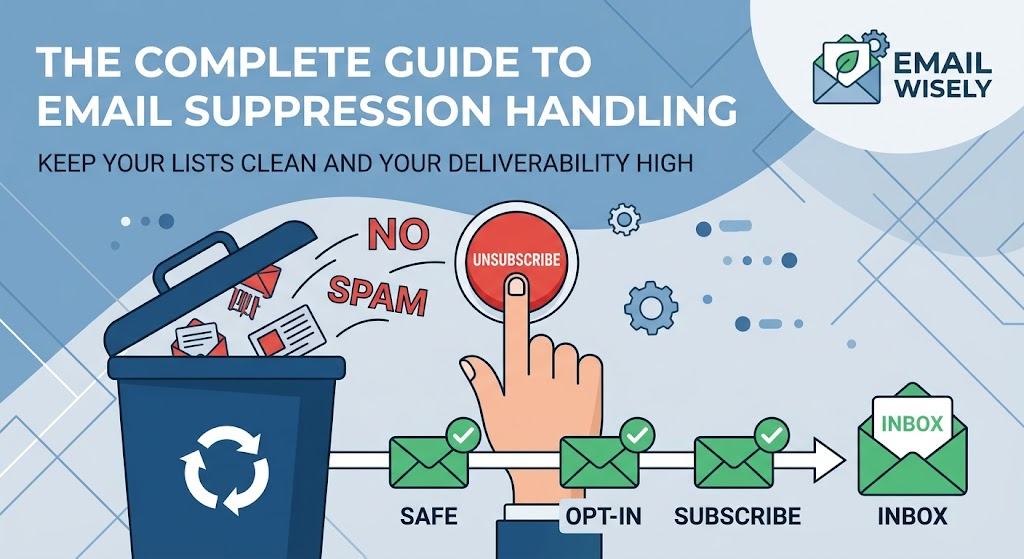
Suppression handling provides a mechanism for an email system to remember recipients that have previously generated problematic delivery events and prevent future messages from being sent to them. Rather than repeatedly attempting delivery to addresses that are known to be invalid, unavailable, or otherwise unsuitable, the system can recognise those recipients and automatically prevent unnecessary delivery attempts.
For businesses sending email at scale, this isn't simply a convenience. It is an important part of maintaining efficient infrastructure, reducing unnecessary delivery failures, and protecting sender reputation.
What is email suppression?
An email suppression list is essentially a record of recipients that should no longer receive emails from a particular sending system.
The reason a recipient may be suppressed can vary. A hard bounce caused by an invalid mailbox is one common example, but suppression can also be associated with repeated delivery failures, spam complaints, manual exclusions, or other events that indicate continuing to send to that recipient isn't appropriate.
The important part isn't necessarily the reason itself. The important part is that the sending system remembers the outcome.
Imagine an application sends an email to:
The receiving server responds with a permanent failure indicating that the mailbox doesn't exist.
Without suppression handling, the application may have no reason to remember that result. A day later, another process sends an email to the same address and the entire delivery process happens again.
The message is queued, a connection is established, the recipient server is contacted, the message is rejected, and another failure is generated.
The system has essentially repeated work it already knows is unlikely to succeed.
With suppression handling, the outcome of the first attempt can instead become part of the system's future decision-making.
The next time the application attempts to send to that address, the recipient can be identified as suppressed before the message enters the delivery pipeline.
That simple change can have a significant impact on the way an email system operates.
Why does suppression matter?
At a basic level, suppression prevents your infrastructure from repeatedly attempting delivery to recipients that are already known to be problematic.
That means fewer unnecessary SMTP connections, fewer predictable delivery failures, less processing and less noise in your delivery logs.
But there is another important reason suppression matters: sender reputation.
Email providers use a wide range of signals when determining how they should treat messages from a particular sender. Delivery behaviour, bounce rates, spam complaints, authentication, sending patterns, domain reputation and IP reputation can all form part of the broader picture.
No single feature can guarantee inbox placement, and suppression isn't a magic solution for deliverability. However, repeatedly attempting to send to recipients that you already know are invalid or problematic is certainly not good sending hygiene. So if there is any chance for an email to be accepted due to good sender behaviour, this is one of the steps in the right direction to help improve your overall efforts.
Your email system needs to learn from its failures
One of the easiest ways to think about suppression handling is to treat it as a feedback mechanism.
Consider a basic delivery flow:
Your Application
       |
       v
   Email API
       |
       v
   Mail Queue
       |
       v
 SMTP Delivery
       |
       v
Recipient Server
       |
       v
 Delivery Result
The delivery result could indicate that the email was accepted, temporarily rejected, permanently rejected, or otherwise failed.
A robust email system doesn't simply record that result and move on.
It uses that information to determine what should happen next.
If a recipient has generated a permanent failure, for example, continuing to send to that address doesn't provide any benefit. The system has learned something about that recipient, so future delivery attempts should be able to take that information into account.
This creates a feedback loop:
Send
  ↓
Delivery Result
  ↓
Analyse Result
  ↓
Update Recipient State
  ↓
Future Sending Decision
Suppression handling is one part of making that feedback loop automatic.
What happens without suppression?
Suppose your application has 100,000 contacts.
Over time, some of those addresses will inevitably become invalid. People change jobs, domains disappear, mailboxes are closed, addresses are mistyped, and temporary infrastructure problems can turn into permanent delivery failures.
Without suppression handling, your application may continue attempting to send to those addresses every time a campaign, notification, report or automated workflow runs.
That can result in a pattern like this:
Campaign 1 → recipient → bounce
Campaign 2 → recipient → bounce
Campaign 3 → recipient → bounce
Campaign 4 → recipient → bounce
Campaign 5 → recipient → bounce
The problem isn't just the individual failed message.
At scale, these repeated failures become part of your overall sending behaviour.
With suppression:
Campaign 1 → recipient → bounce → suppress
Campaign 2 → recipient → suppressed
Campaign 3 → recipient → suppressed
Campaign 4 → recipient → suppressed
Campaign 5 → recipient → suppressed
The system has effectively learned that continuing to send to that address isn't useful.
That is a much more efficient model.
Suppression isn't as simple as maintaining a list
At first glance, implementing suppression handling yourself can seem relatively straightforward.
You could create a database table containing an email address and a reason:
email
reason
created_at
Then, before sending an email, your application could check whether the recipient exists in that table.
And technically, that would be a start.
The challenge is building a suppression system that works reliably across a real-world email infrastructure.
Your system needs to understand different SMTP responses and delivery events. It needs to distinguish between temporary and permanent failures. It needs to determine when a recipient should be suppressed and when another delivery attempt may still make sense.
It also needs to consider what happens when multiple applications or workers are sending simultaneously.
What happens if two processes attempt to send to the same recipient at exactly the same time?
What happens if an address is suppressed while another message is already sitting in a delivery queue?
What happens when a user imports a contact list containing an address that your system has previously suppressed?
What happens if a suppression needs to be removed?
What happens when you have multiple sending applications that all need to respect the same suppression state?
These are the types of problems that make suppression handling much more than a simple database lookup.
Creating a suppression list is easy. Building suppression handling that you can trust is another story.
Temporary failures and permanent failures
One of the more important technical considerations is that not every delivery failure means the same thing.
An SMTP server may return a temporary error because it is busy, rate limiting the sender, experiencing an internal issue, or temporarily unable to accept the message.
A different response may indicate that the recipient simply doesn't exist.
Those two situations should not necessarily be treated identically.
A temporary failure may warrant another delivery attempt later.
A permanent failure may indicate that continuing to retry is pointless.
This is why effective suppression handling requires more than simply saying:
"If an email bounces, suppress it."
A proper system needs to understand the nature of the failure and apply appropriate logic.
That classification happens inside the email infrastructure and is one of the reasons why implementing a robust delivery system can become considerably more complicated than initially expected.
Suppression as an infrastructure control
There is also a broader technical benefit to suppression: it allows your email infrastructure to make better decisions before sending occurs.
Without suppression, every email request can potentially travel through your entire delivery pipeline.
With suppression, the system can perform an early check:
Email Request
      |
      v
Is recipient suppressed?
      |
   +--+--+
   |     |
  Yes    No
   |     |
 Stop   Queue
         |
         v
      Deliver
This means a known-problematic recipient can be stopped before consuming additional delivery resources.
For high-volume systems, this matters.
Every unnecessary delivery attempt potentially involves application processing, queue operations, worker capacity, network connections, SMTP communication, logging and response handling.
Preventing that work before it happens is more efficient than repeatedly processing a failure after the fact.
Suppression and sender reputation
Sender reputation is one of the most important parts of email deliverability.
Your sending domain and IP infrastructure develop a history based on how recipients and receiving mail systems interact with your messages.
While suppression is only one part of that overall ecosystem, preventing repeated attempts to problematic recipients can contribute to healthier sending behaviour.
Think of it as basic hygiene.
If your system has already established that an address is invalid, continuing to send to it doesn't improve anything. It creates another opportunity for a failed delivery and another unnecessary event for your sending infrastructure to process.
Over time, maintaining cleaner recipient data can help your system operate more efficiently and reduce avoidable negative delivery signals.
This is especially important for businesses sending large volumes of transactional or marketing email, where even relatively small percentages of problematic recipients can translate into thousands of failed delivery attempts.
The security perspective
Suppression handling can also be viewed from a security and risk-management perspective.
Email systems are frequently connected to other parts of an organisation's infrastructure. An application might automatically send account notifications, invoices, password resets, alerts, reports or other messages.
If an application is misconfigured, compromised, or simply supplied with poor-quality recipient data, it can potentially generate a large number of unnecessary delivery attempts.
A suppression layer provides an additional control between the application requesting the email and the underlying delivery infrastructure.
Instead of blindly processing every request, the email system can use historical delivery information to determine whether the recipient should continue through the pipeline.
This becomes particularly useful when multiple applications share the same email infrastructure.
Rather than requiring every application to independently understand every delivery failure and maintain its own suppression logic, suppression can be handled centrally at the email infrastructure layer.
That creates a more consistent enforcement point.
Centralised suppression makes systems simpler
Imagine a company has three different applications sending email.
There is a web application, a customer management system and an internal platform.
If every application manages suppression independently, you might end up with three different implementations:
Application A
     ↓
Suppression Database A

Application B
     ↓
Suppression Database B

Application C
     ↓
Suppression Database C
Now the organisation has three systems that need to correctly interpret delivery failures, update recipient status and prevent future sending.
A centralised email provider can instead provide a common suppression layer:
Application A ─┐
Application B ─┼──→ Email Infrastructure
Application C ─┘             |
                              ↓
                     Suppression Handling
The applications can focus on their actual business logic while the email infrastructure handles the complexities associated with email delivery.
This separation of responsibilities can make systems easier to maintain and reduce duplicated logic across applications.
How Maileroo handles suppression
This is where automated suppression handling becomes particularly useful.
When you send email through Maileroo using SMTP or the Email API, your application doesn't need to build its own complete suppression system from the ground up.
Maileroo processes delivery events and can automatically suppress recipients that should no longer receive future messages based on the relevant delivery outcomes.
Instead of your application having to repeatedly deal with the same failed recipient, the email infrastructure can handle that state for you.
The general flow looks something like this:
Your Application
       |
       v
 Maileroo SMTP / API
       |
       v
 Delivery Infrastructure
       |
       v
 Recipient Mail Server
       |
       v
 Delivery Response
       |
       v
 Failure Processing
       |
       v
 Suppression Handling
       |
       v
 Future Delivery Attempts
       |
       v
 Suppressed recipients are prevented
 from unnecessary future sends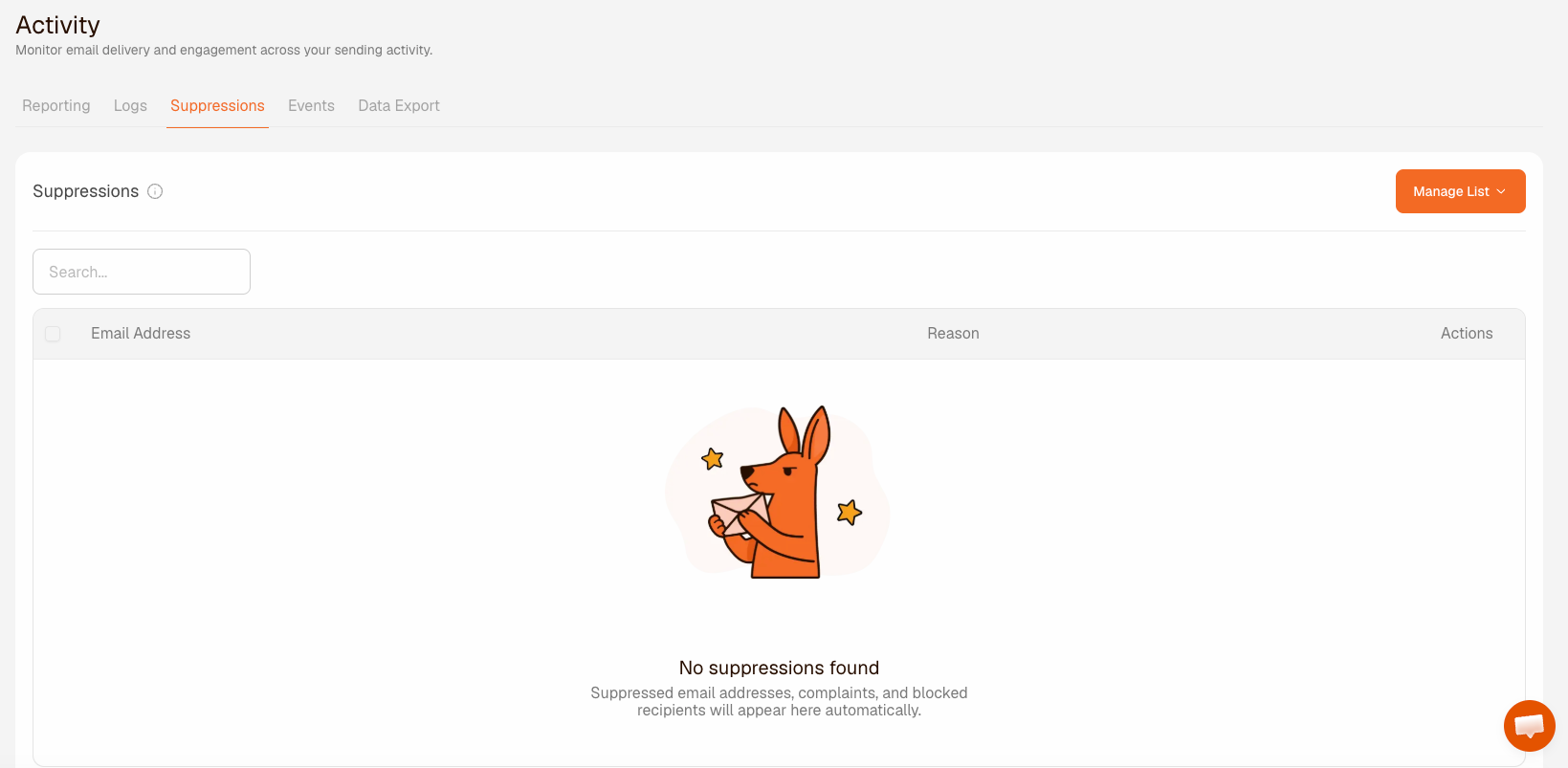
The key advantage is that this happens as part of the delivery infrastructure rather than requiring every application to implement the entire process itself.
The amazing thing too is that you can also take matters into your own hands too. Whilst you have the comfort of an automated system handling these suppressions for you, you can bring across from your own database to import your existing list of suppressed emails to further buff up your email delivery system.
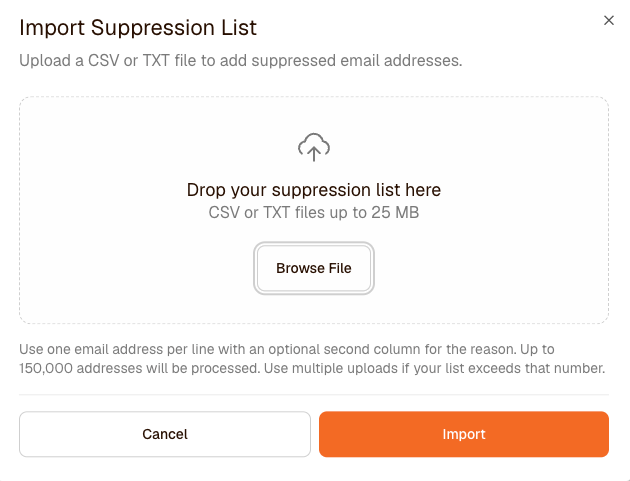
Should you need to export this list too, the option is available as well.
SMTP and Email API support
One of the benefits of handling suppression at the infrastructure level is that it can work regardless of how your application connects to the email service.
Whether your application communicates with Maileroo through SMTP or the Email API, suppression handling can sit underneath the sending process.
For developers, this means you don't necessarily need to redesign your application's email logic simply to introduce suppression.
Your application can continue making its normal email requests while the underlying email infrastructure handles delivery processing, failure classification and suppression.
This creates a useful separation:
Your application decides who it wants to communicate with.
Your email infrastructure helps determine whether that recipient should actually enter the delivery pipeline.
Suppression shouldn't mean losing control
Automation is useful, but developers still need visibility and control over their email data.
That's why suppression handling shouldn't be treated as a completely hidden process.
There are situations where businesses may already have their own suppression lists before moving to a new email provider. Being able to import that data means you don't have to start from scratch or accidentally reintroduce recipients that your existing system has already identified as problematic.
The same applies when exporting suppression data.
Your suppression information is part of your email infrastructure and operational data. Being able to access and manage it gives you greater control over how your organisation handles recipient data.
Automation should remove repetitive work, not remove control.
Suppression handling reduces complexity in your application
One of the biggest advantages of moving suppression handling into the email infrastructure is that it keeps unnecessary email-specific complexity out of your application.
Your application shouldn't need to understand every SMTP response.
It shouldn't need to maintain a complicated retry system.
It shouldn't need to determine whether a recipient should be permanently suppressed.
It shouldn't need to build its own delivery-state management system simply to make sure that known-bad recipients aren't repeatedly contacted.
Those are problems that belong much closer to the delivery layer.
Your application should be able to say:
"Send this email to this recipient."
The email infrastructure should then handle the complexities of actually delivering that message reliably.
This is one of the fundamental advantages of using an email delivery platform rather than attempting to build every component internally.
A small feature with a much bigger impact
Suppression handling can easily be overlooked because, unlike an email API or SMTP relay, it isn't something developers necessarily interact with directly every time they send a message.
But that doesn't make it insignificant.
In fact, suppression is one of those infrastructure features that becomes more valuable as your sending volume increases.
Sending a few hundred emails manually may not expose the problem.
Sending hundreds of thousands or millions of emails certainly can.
At scale, small inefficiencies become large operational problems. A small percentage of invalid recipients can produce thousands of unnecessary delivery attempts. A poorly implemented suppression system can result in repeated failures, additional processing and unnecessary complexity throughout the sending stack.
Automating that process allows your infrastructure to continuously learn from delivery outcomes and use that information to make better decisions.
Summary
Email delivery isn't just about getting messages from point A to point B.
A mature email infrastructure needs to understand the entire lifecycle of a message, including what happens when delivery fails.
Suppression handling provides an important part of that lifecycle.
It allows systems to remember problematic recipients, prevent unnecessary future delivery attempts, reduce repetitive processing and maintain cleaner sending practices.
For developers, it can also remove a considerable amount of complexity from the application itself. Instead of every application independently implementing failure classification, suppression logic, retries and recipient state management, these responsibilities can be handled by the infrastructure designed specifically for email delivery.
At Maileroo, suppression handling is built into the sending infrastructure across both SMTP and the Email API, allowing applications to benefit from automated suppression without having to build the entire system themselves.
Because ultimately, reliable email infrastructure isn't just about knowing how to send an email. It's also about knowing when not to send one.