


SMTP Hosting You Set Once and Forget
Drop our credentials into WordPress, Laravel, Ghost, or something your team wrote in 2011, and mail starts moving. Live logs show what happened to every message, and support comes from the engineers who run the platform.



 Hosting Essentials
What Comes With the Hosting
Everything below is on every plan, including the free tier. There is no add on pricing for logs, webhooks, or tracking, and no feature gate that only opens at enterprise volume.

Copy the host, port, username, and password into your application settings and send a test. No mail server to patch, no queue to babysit, no PTR records to chase.

If you would rather talk HTTP than port 587, the REST API covers the same sending, template rendering, and suppression handling, with SDKs for the major languages.

Move onto your own IP when volume justifies it and own your reputation outright, rather than sharing a pool with senders you have never met.

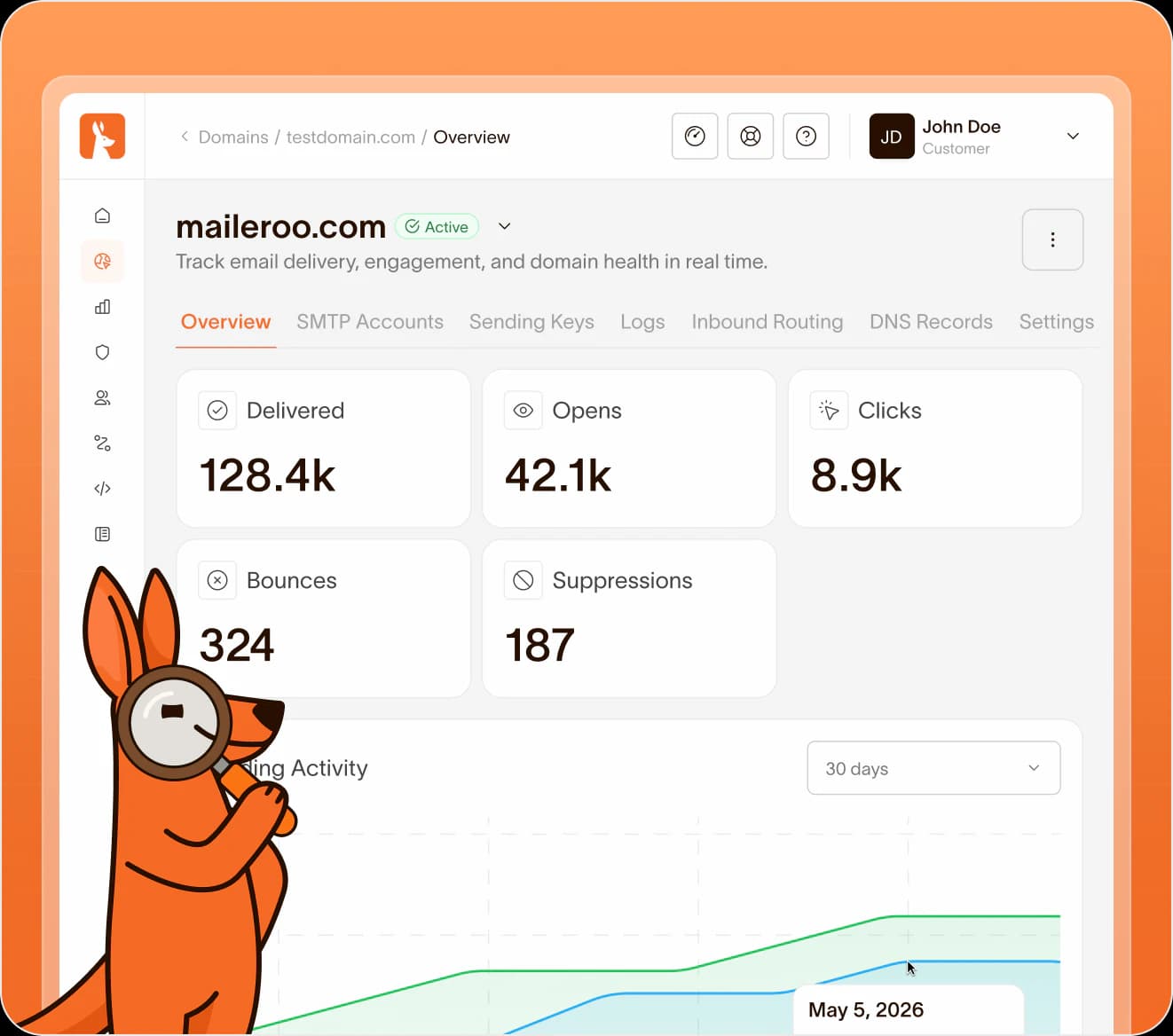
Delivery, open, click, bounce, and complaint rates in one view with 30 days of history. Plain numbers, no dashboard archaeology required.

Delivery and engagement events post to your endpoint as they happen, with retries and per endpoint backoff, so your app never polls us on a timer.

Live chat and email reach people who run the infrastructure. Ask about warmup, authentication, or a placement drop and you get an answer, not a case number.
 Configuration
Set It Up Once,
Then Stop Thinking About It
Two things tend to decide whether hosted SMTP is worth it: how quickly it connects, and how much you can see once mail is flowing.
Credentials, Domains,
and Sending Rules
Add a domain, apply the SPF and DKIM records we generate, and verification completes on its own. Cloudflare users can do the whole thing in one click without disturbing existing records.
From there you issue as many SMTP credentials as you need. Scope each one to a domain, restrict it to an IP range, and revoke it on its own if a vendor or a device ever needs cutting off.
Every Message Logged
and Searchable
When a customer says an email never arrived, you can answer with the raw SMTP conversation rather than a guess. Logs hold 14 days of activity, filterable by status, recipient, and subject.
Failed or suppressed messages can be resent from the dashboard, suppression lists update themselves on hard bounces and complaints, and blacklist monitoring watches your domains and IPs across the major RBLs.
 Delivery Pipeline
What Happens After You Hit Send
Average end to end delivery sits at 1.6 seconds. Here is what the platform does inside that window, so nothing about the process is a black box.
 European Infrastructure
SMTP Hosting Inside the European Union
Sending infrastructure sits in Germany, the Netherlands, Finland, and France. That location is a deliberate compliance choice, not an artefact of where capacity happened to be cheap.

Message content, recipient data, and logs are processed and stored inside the EU, so your data residency answer is short and does not involve transfer mechanisms.
Our primary Netherlands facility is operated to ISO/IEC 27001 standards, with redundant power, physical access control, and energy efficient cooling.
A data processing addendum is available to every customer, covering sub processors, retention, and breach notification without a negotiation cycle.
TLS is enforced on submission and opportunistic on delivery, and data at rest is encrypted. Dedicated IPs can be pinned to a specific region on request.

 Hosting Plans
SMTP Hosting From $10 a Month
Pricing follows how many emails leave your account, not how many seats or features you use. Start free at 3,000 emails and move up when your sending does.

Pick a plan based on how many emails you send each month. You can upgrade, downgrade, or cancel anytime. No lock-in, no hidden fees.
 Includes 2 domains
 Includes Email Testing
 FAQ
FAQQuestions?
Setup time, supported platforms, dedicated IPs, log retention, and migration: the details worth checking before you point production at us.
A relay you authenticate against instead of running a mail server yourself. We hold the IP reputation, the queueing, the retry logic, the feedback loops, and the delivery reporting. You keep the credentials and your application code.
Sending on our sandbox domain works as soon as you have credentials. Sending from your own domain waits on DNS: add the SPF, DKIM, and DMARC records we generate, then verification usually completes within minutes.
Anything that speaks SMTP. WordPress, Ghost, Laravel, Django, Rails, Node, and legacy in house applications all connect the same way, using smtp.maileroo.com on port 587 with STARTTLS.
Yes. Every account includes a sandbox domain, so you can send real messages and inspect the logs before you touch production DNS or commit to a paid tier.
Once your monthly volume is consistent and large enough to warm an IP properly. Plans at 250,000 emails a month and above include one at no extra cost, and it can be added to smaller plans on request.
In the European Union, across Germany, the Netherlands, Finland, and France. Message data stays in region, which is what makes the GDPR position straightforward rather than something you have to argue about.
Email logs are searchable for 14 days with filters on status, recipient, and subject, and analytics cover 30 days. Both are exportable if you need to keep records for longer than that.
Yes. Verify your domain here while the old provider keeps sending, import your suppression list, then swap the credentials in your application. The cutover is a config change, not a maintenance window.
 Features
Crafted for a Delightful Email Experience
Everything behind reliable delivery at any volume: sending, verification, routing, and the analytics to see what happened, from first API call to millions a month.

SMTP Relay
Send transactional and bulk emails through reliable SMTP infrastructure built for speed, security, and deliverability.

Email API
Integrate email delivery into your applications using powerful APIs built for flexibility, scalability, and performance.

Streams
Separate transactional and marketing traffic into isolated sending streams to protect reputation and keep critical emails fast.

Inbound Routing
Receive and route incoming emails directly into your applications using flexible automation and processing workflows.

Email Marketing
Create and deliver marketing campaigns designed to increase engagement, reach, and customer retention.

Webhooks
Receive real-time event notifications for deliveries, opens, and clicks for storage and automation workflows.

Analytics
Monitor email performance with detailed insights, reporting tools, and actionable delivery metrics in real time.

Email Testing
Capture, inspect, and validate every message in a safe sandbox, with authentication checks and spam analysis before going into production.

Developer SDKs
Build integrations faster using SDKs, code examples, and resources for modern application development.
